Almost every week somebody rings and asks for a sweep when what they need is an inspection, or books an inspection when the flue plainly wants brushing. They are not the same job, they do not cost the same, and doing the wrong one is a waste of a morning. Here is how we tell them apart.
What each one actually is
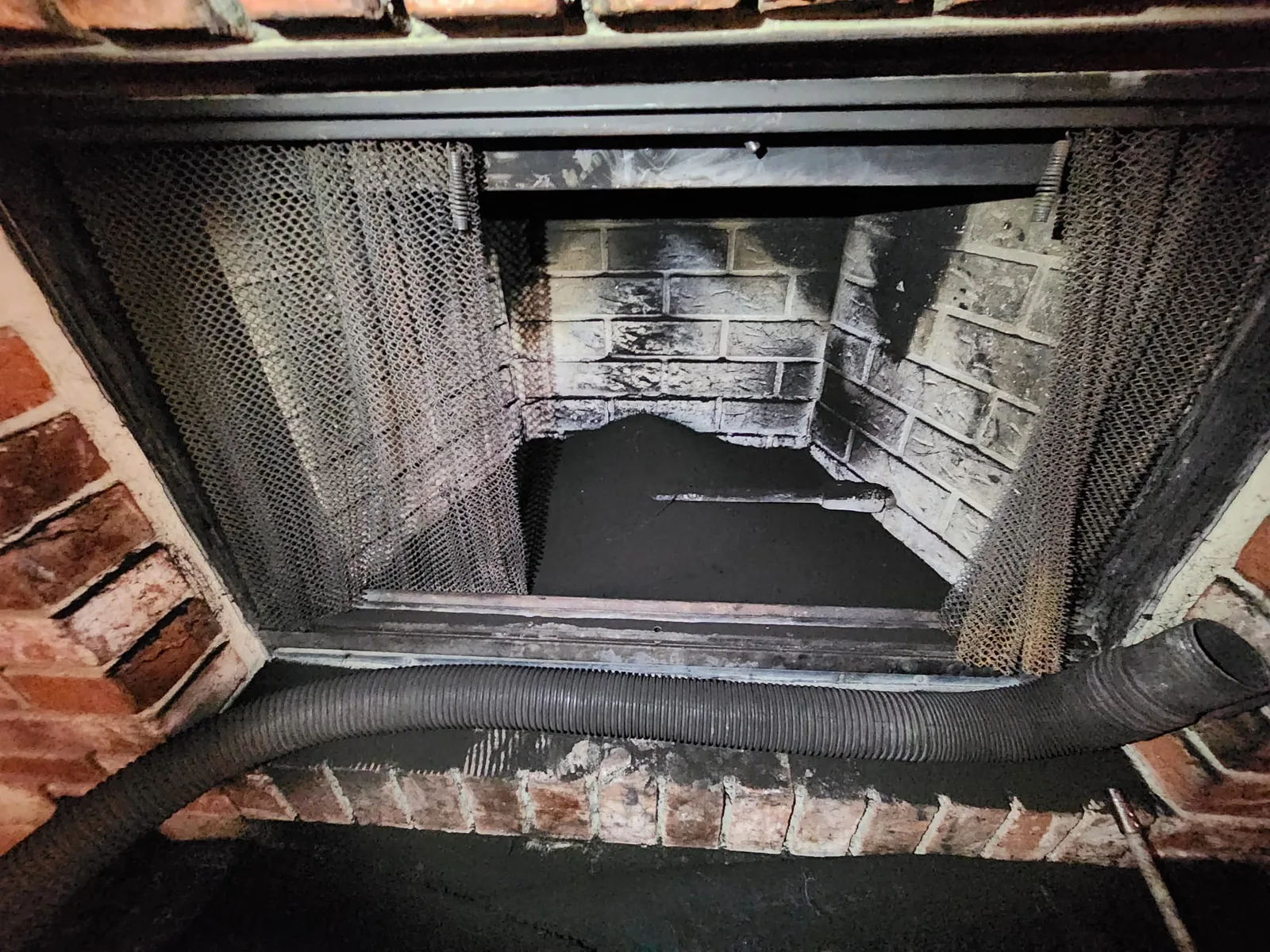
A sweep is mechanical. Rods and a rotary brush go the full length of the flue, a HEPA vacuum runs the whole time to keep the soot in the machine rather than the room, and the smoke shelf and firebox get cleared by hand. It removes material. It does not, by itself, tell you much about the condition of the masonry.
An inspection is diagnostic. A camera goes down the flue and the whole system gets examined component by component — firebox, damper, smoke shelf, liner, crown, cap and flashing. It tells you what you own and what state it is in. It removes nothing.
Most of our visits are both, because once the rods are out it costs very little extra to film what is behind the soot. But if you are choosing one, the question is whether your problem is material or condition.
Signs you need a sweep
- You burn wood regularly — most weekends through the winter — and it has been a year or more.
- Black, tarry flakes are dropping into the firebox or collecting on the smoke shelf.
- The fire is harder to get going than it used to be, or needs constant attention to stay lit.
- There is a strong campfire smell in the room even when nothing is burning, especially on warm days.
Signs you need an inspection instead
- You are buying or selling the house. NFPA 211 calls for a Level 2 inspection on a property transfer, and a sweep does not satisfy it.
- Nobody can tell you when the chimney was last looked at, and you have not lit a fire since moving in.
- There is a stain on the ceiling or the chimney breast, or white powdery bloom on the brick outside.
- The chimney has been through an earthquake, a storm, or a flue fire.
- Your insurer or a home inspector has asked for a report.
The awkward middle case
The one that catches people out: light users. If you light three or four fires a season there will not be enough creosote to justify brushing, but the flue has still spent twelve months collecting moisture, wildlife and whatever the mortar has shed. That is an inspection year, not a sweep year. It is also the cheapest visit we do, which surprises people who assumed the opposite.
The reverse case is a heavily used flue that has never been filmed. There the sweep has to happen first, simply because you cannot see a cracked tile through a quarter inch of glaze.
What glazed creosote changes
Worth knowing about, because it changes the price. Ordinary creosote is flaky and brushes off. Glazed creosote is the hard, shiny, tar-like kind that forms when a flue runs cool — burning unseasoned wood, or damping a fire down overnight, will produce it. It cannot be brushed. It has to be ground off or chemically treated, and that is a longer job at a higher price. If we find it we will tell you before starting rather than halfway through.
If you genuinely cannot tell
Ring and describe what the fireplace is doing. Four answers usually settle it: what you burn, roughly how often, when it was last touched, and whether anything looks or smells wrong. That is a two-minute conversation and it is free, which is a good deal better than paying for the wrong visit.